
From Vision to Reality
Our client had never worked in games. But for years he'd been carrying around the idea for one he knew should exist. What he didn't have was any way of making it happen.
Teef is a crime game. You play a pickpocket working the streets of London, earning money, building a crew and pulling off ever more high-stakes crimes. The aesthetic is cyberpunk, the gameplay stealth and the original vision mixed in real money, geo-location and real-time PvP.
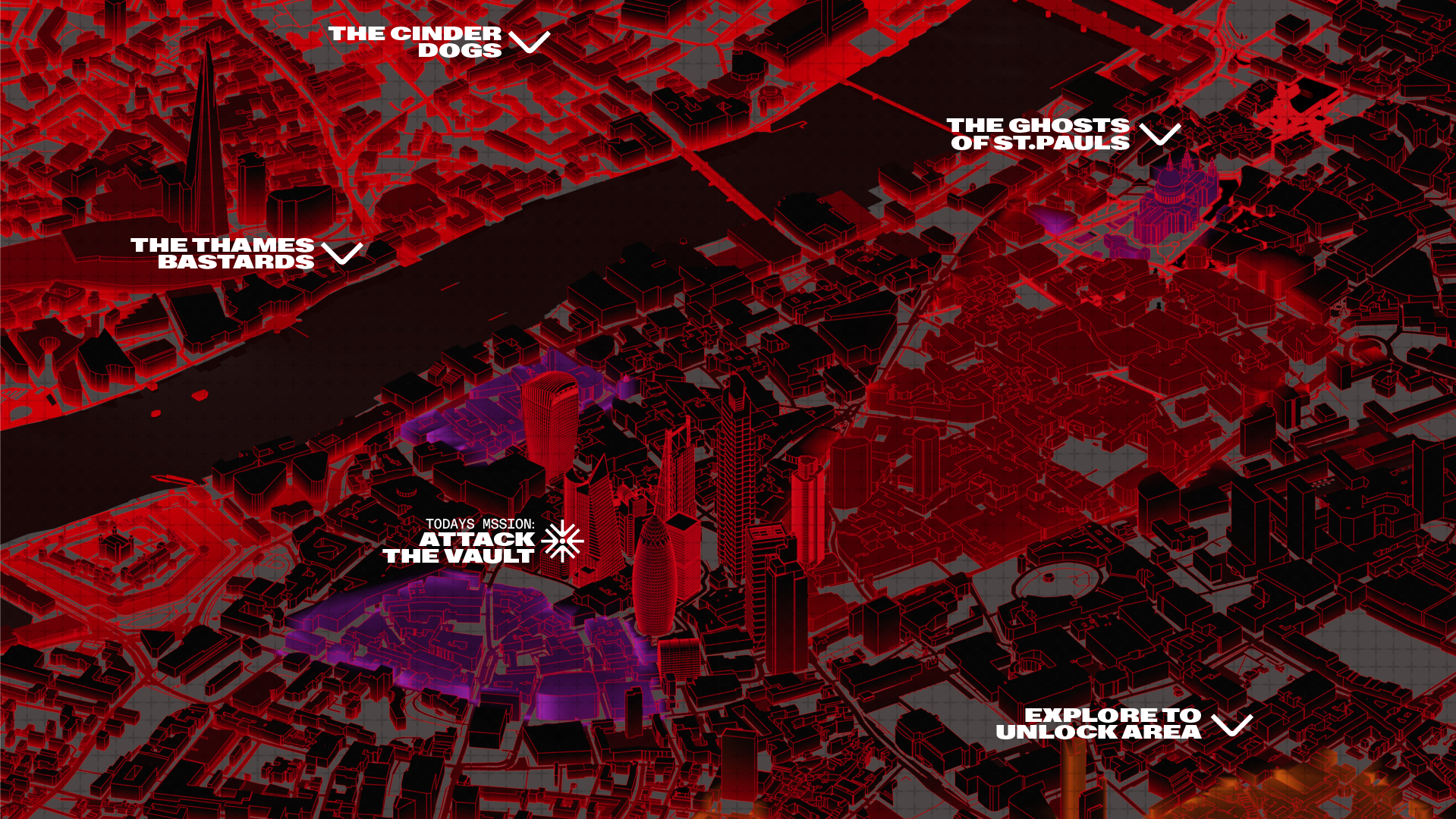
It was detailed and ambitious. But whether it would actually work as a game was something nobody could know from a design document. The only way to find out was to test it.
Mapping onto a game
The document detailed the world, aesthetic and player goal. What it didn't cover was how any of that became a core loop, or an effective economy. Those are the two things everything else in a game depends on, luckily they're cheap to explore.
So we mapped out different versions. Five takes on the core loop, each borrowing its shape from a genre that already works, and two ways the economy could run. In the first, players steal real money from each other, with the player base segmented from minnow to whale to ensure a fair balance. In the second, players craft and sell to each other through an auction house, with crime tiers running from pickpocketing up to complex heists that need specialised tools.
Each version leads to a different game with a different audience, and the trade-offs aren't obvious unless you've built games like these before. Laying the options out side by side made that clear to our client, so he could weigh each one and choose a direction.
Ten days to playable
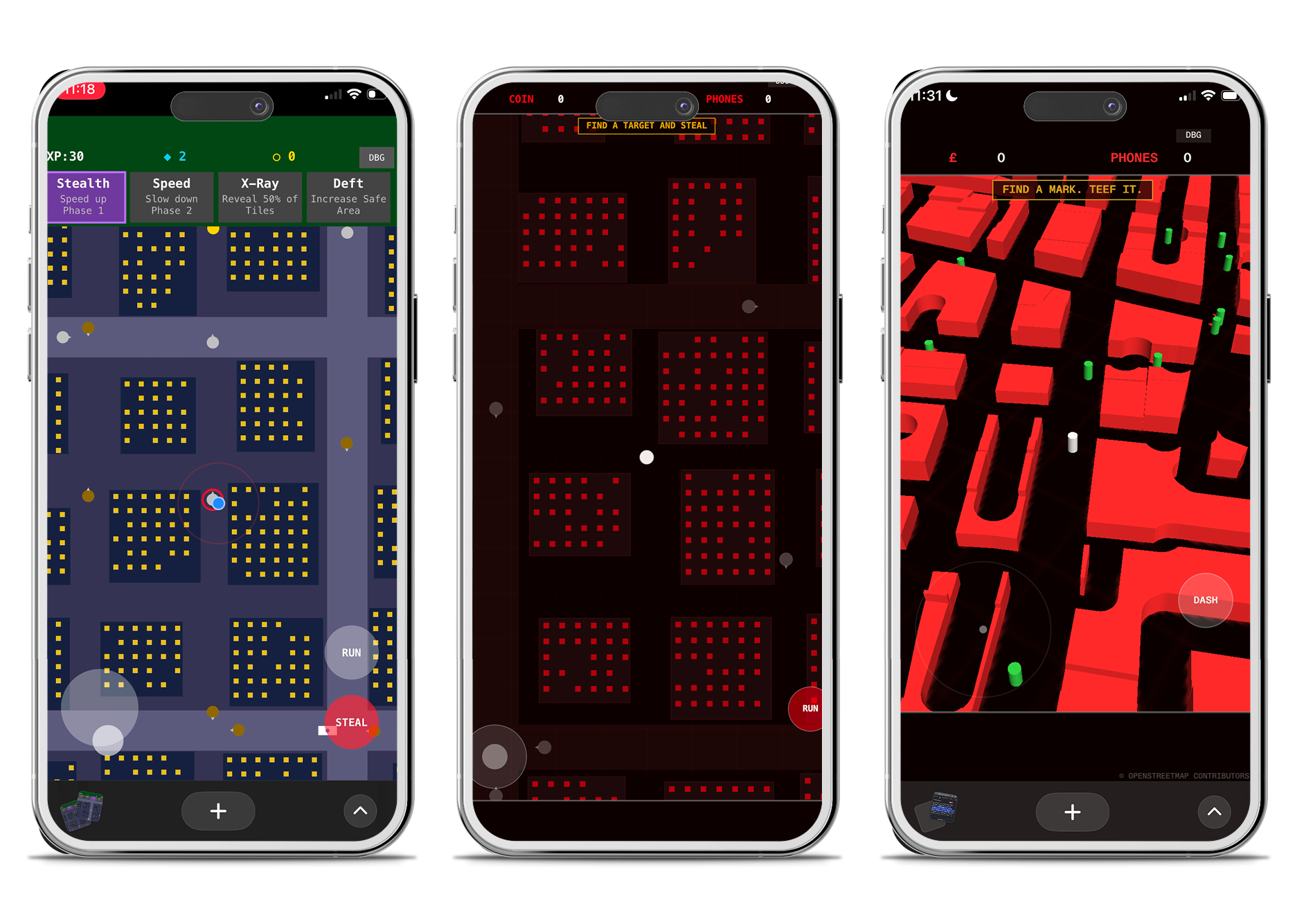
The next step was to understand whether the stealing loop was actually fun. We specced a tight prototype, and ten days after we agreed on it our client was play-testing.
And finding out it wasn't actually very fun. Our first version of the stealing loop had no jeopardy, so we added a skill element and a suspicion meter. Now NPCs could notice you stealing, and, if you weren't careful, chase you through the city and take some of your cash.
He loved it:
"I walked to the gym after playing around with it for 45 minutes, and it was really cool, because I was looking at central London in the same way. Looking at the different angles and thinking about areas that were a bit of a bottleneck."
With a fun, playable build, the project really shifted gears.
Main character
From there the map became the main character. It grew from a flat, regular grid to a 2.5D version of real London streets, Soho in fact. This made a huge difference, because those 17th century streets are far less regular than what we began with. Bottlenecks, dead ends and sightlines introduced strategy into stealing locations and jeopardy into chases, making the core loop much more fun.
Something nobody predicted
Having locked in the loop, economy and environment, we could turn our attention to the art style. This mattered a great deal to our client, and it's an important element to nail down early. Parts of a game like copy can be changed quickly, an aesthetic cannot. Making a mistake means the marketing won't resonate and assets have to be rebuilt, which is time-consuming and expensive.
So we made three directions, deliberately distinct so the result would separate cleanly:
Urban cyber. Red, white and black with graphic overlays, closest to the client’s vision.
Black and white brutalist. Near-monochrome, stark concrete environment and dystopian avatars. Not something you see often in UA, which we weren't sure meant standing out or crashing out.
Casual. The proven mobile look with an edge. Bright colours, street fashion, in a recognisable London.
Each was built into a video ad, linked to its own store listing so installs could be attributed cleanly, with identical structure across all three so the only variable was the art.
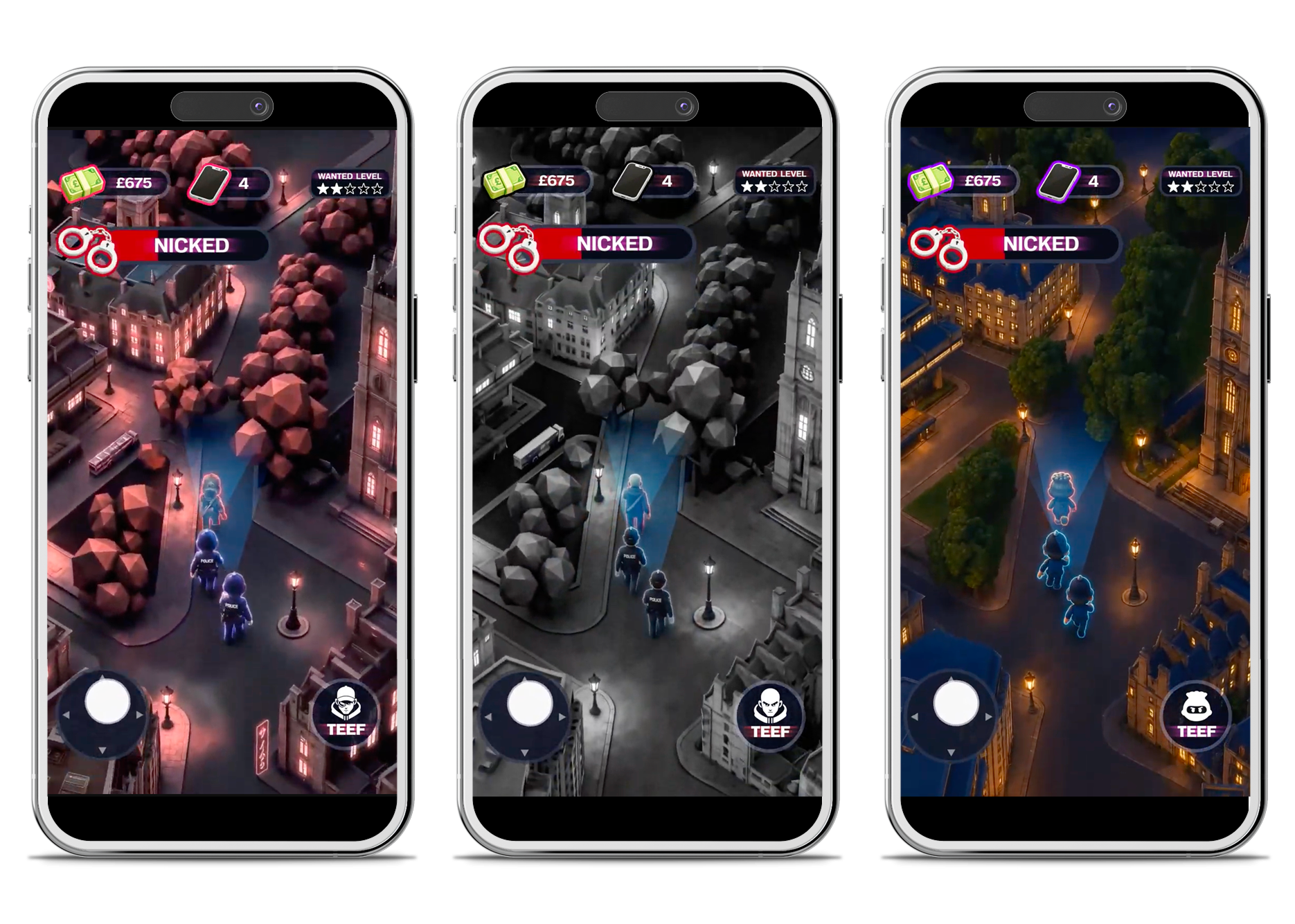
Once the ads were ready, the test was in field for five days until we had a clear result. The winner reached five times as many people as either of the others and held its cost per install the whole way. All were efficient, only one of them scaled: Brutalist.
We hadn't expected it to win. And it wasn't our client's favourite, but he backed it anyway. As he put it:
"Show me that it works and I'll support it completely. Or show me it's fun, or that someone else thinks it's fun. Not just me, because I love this and I think it's super cool. But I'm not the arbiter of fun."
Where it stands
The core loop is prototyped and tested. The economy and meta are modelled across the first 90 minutes. The art direction has been tested against real installs.
Whether players retain is the next question. But our client now knows what his game feels like to play, what it'll look like and how it'll make money. Before we started working together, he had a PDF.